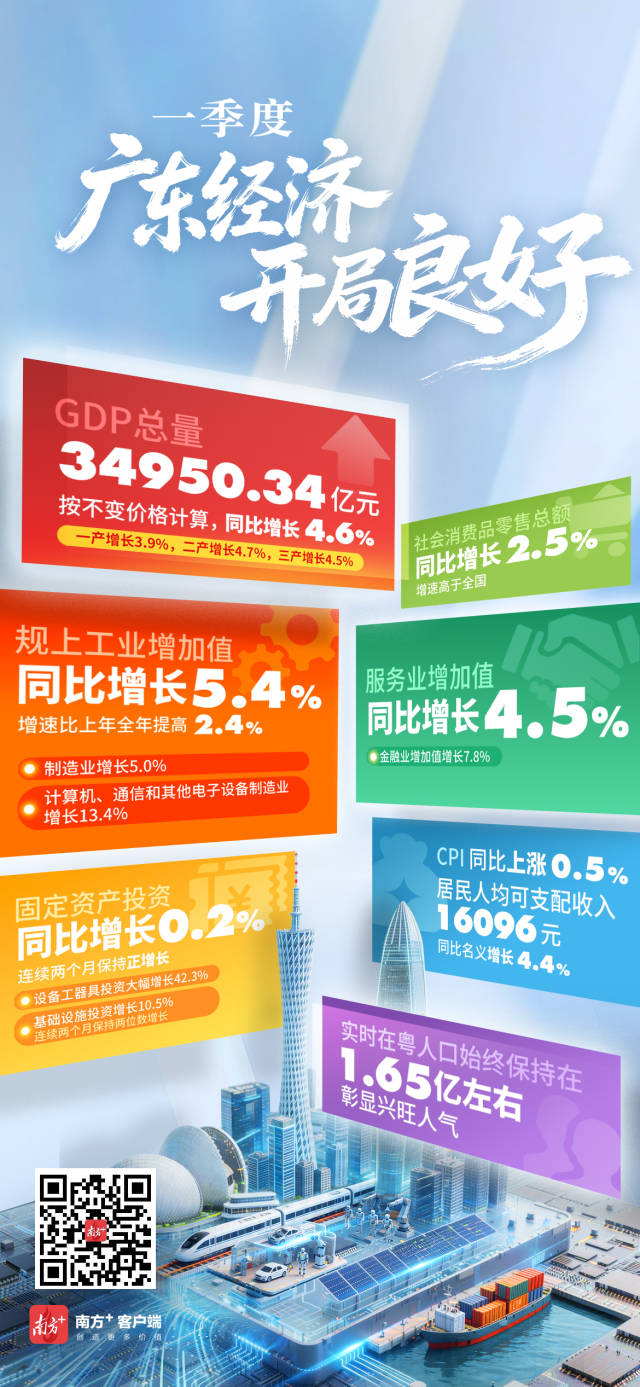
According to the unified accounting results of regional gross domestic product, Guangdong achieved a regional GDP of 3.495034 trillion yuan in the first quarter, representing a year-on-year increase of 4.6% at constant prices.
On April 21, the Guangdong Provincial Bureau of Statistics released a brief overview of the provincial economic performance in the first quarter. Data shows that since the beginning of this year, the growth rate of major macroeconomic indicators in Guangdong has picked up. The overall economy has maintained a recovering and improving momentum, marking a strong start to the year.
The added value of industrial enterprises above designated size increased by 5.4% year-on-year, 2.4 percentage points higher than the full-year figure of 2025; the added value of the service sector rose by 4.5% year-on-year; and total retail sales of consumer goods grew by 2.5% year-on-year, outpacing the national average.
In addition, fixed-asset investment edged up by 0.2% year-on-year, staying in positive growth for two consecutive months. Excluding real estate development investment, provincial fixed-asset investment grew by 5.8%.
Analysts from the Guangdong Provincial Bureau of Statistics pointed out that despite the complex and severe external environment and the need to further consolidate the foundation of economic recovery, the province boasts a solid economic foundation, robust new quality productivity drivers, continuously unleashed policy effects, and growing development vitality. These factors provide solid support for sustained economic recovery and growth.
I. AI Boom Drives Rapid Expansion of the Electronics Industry
In the first quarter, provincial agricultural production grew steadily with stable supply of major agricultural products. The total output value of agriculture, forestry, animal husbandry and fisheries increased by 4.3% year-on-year. Meanwhile, industrial production accelerated and new quality productivity developed at an accelerated pace. The added value of industrial enterprises above designated size across the province rose by 5.4% year-on-year, an increase of 2.4 percentage points from 2025.
By sector, the mining industry achieved double-digit growth of 18.8%, 15.8 percentage points higher than the previous year. The manufacturing sector, and the production and supply of electric power, heat power, gas and water grew by 5.0% and 5.2% respectively, up 1.8 and 4.9 percentage points.
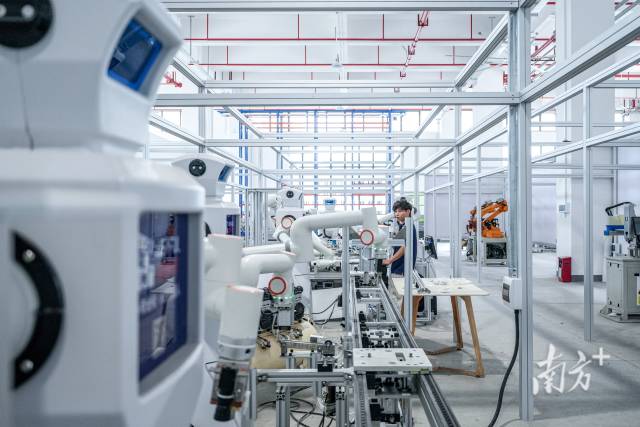
Key industries provided steady support. Among them, the manufacturing of computers, communications and other electronic equipment increased by 13.4% year-on-year, 6.3 percentage points higher than the full-year growth of last year. The provincial statistics authority noted that the restoration of state subsidies has boosted demand for electronic products, and the rapid development of the AI industry has driven higher demand for hardware such as memory chips. The electronics industry maintained high-speed growth with a strong driving effect. Double-digit growth was registered in the added value of the computer, communication and electronic equipment manufacturing sector, contributing 3.6 percentage points to the growth of industrial added value above designated size.
In the first quarter, the added value of advanced manufacturing and high-tech manufacturing increased by 7.0% and 11.9% respectively, 1.6 and 6.5 percentage points higher than that of overall industrial enterprises above designated size. Their respective proportions in total industrial output reached 56.7% and 34.8%, rising by 0.5 and 0.1 percentage points year-on-year.
Since the start of the year, the output of high-tech products has surged. Output of industrial robots, 3D printing equipment, integrated circuits and memory chips increased by 45.2%, 63.6%, 43.1% and 32.0% respectively.
II. Operating Revenue of Service Enterprises Above Designated Size Up 6.4% Year-on-Year
This year’s Provincial High-Quality Development Conference highlighted the coordinated development of manufacturing and service industries. How did the service sector perform in the first quarter?
Data shows the added value of the service industry grew by 4.5% year-on-year, with the financial industry, and accommodation and catering industry rising by 7.8% and 4.0%. From January to February, the operating revenue of service enterprises above designated size increased by 6.4% year-on-year.
Rapid revenue growth was recorded in information transmission, software and information technology services (7.5%), leasing and business services (9.2%), and scientific research and technical services (16.3%). Specifically, revenue of internet-related services and software and IT services increased by 7.8% and 9.9%.
Transportation operations remained stable. Cargo throughput and freight turnover rose by 3.2% and 9.6% year-on-year, accelerating by 3.0 and 1.6 percentage points. Passenger volume and passenger turnover increased by 8.4% and 8.5%, up 4.9 and 2.3 percentage points. High-speed rail passenger volume and turnover jumped by 13.6% and 10.9%.
Domestic consumption maintained steady growth. Total retail sales of consumer goods in the first quarter went up by 2.5% year-on-year, 0.1 percentage points above the national level. Retail sales in urban areas increased by 2.8%, while rural retail sales grew by 0.2%.
By consumption category, commodity retail sales of above-quota entities grew by 3.1%, and catering revenue rose by 6.1%. Daily necessities and upgraded consumer goods posted solid growth. Retail sales of grain, oil and food, beverages, tobacco and alcohol at above-quota enterprises increased by 7.3%, 7.4% and 5.6%. Sales of communication equipment surged by 26.9%.
Online consumption potential continued to be unlocked. Online retail sales of commodities by above-quota entities increased by 11.4%, 8.3 percentage points faster than overall physical commodity retail sales.
III. Investment in Equipment and Tools Skyrockets by 42.3%
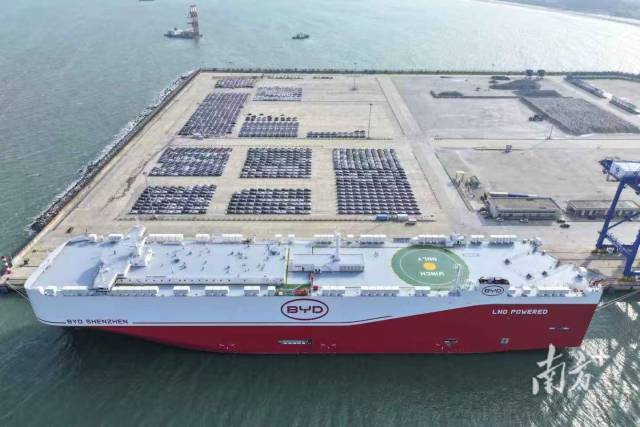
Notably, Guangdong’s fixed-asset investment has remained positive for two consecutive months, rising by 0.2% year-on-year in the first quarter. Excluding real estate development investment, fixed-asset investment across the province grew by 5.8%. Policies for large-scale equipment upgrading continued to deliver results, driving a sharp 42.3% surge in investment in machinery, equipment and tools.
Infrastructure investment grew by 10.5%, maintaining double-digit growth for two months and rising 18.7 percentage points year-on-year. Investment in power and heat supply increased by 12.0%, while investment in internet-related services soared by 524.0%.
Industrial investment increased by 1.4%, with its growth rate up 15.8 percentage points. Investment in computer, communication and electronic equipment manufacturing surged by 43.5%. Real estate development investment dropped by 14.8%, with the decline narrowing by 8.8 percentage points. The sales area of new commercial housing fell by 15.6%, with the contraction easing by 1.5 percentage points.
IV. CPI Growth Widens; Per Capita Disposable Income Hits 16,096 Yuan
In the first quarter, the province’s consumer price index (CPI) rose by 0.5% year-on-year, with the growth margin expanding by 0.7 percentage points compared with 2025. In March alone, CPI increased by 0.7% year-on-year.
The industrial producer price index (PPI) fell by 1.2% year-on-year in the first quarter, with the decline narrowing by 0.3 percentage points. March PPI dropped by 0.3%, 1.4 percentage points milder than February. The industrial purchaser price index (IPI) edged down by 0.1%, with the decline shrinking by 2.7 percentage points. March IPI rebounded to a 1.2% increase from a 0.2% drop in February.
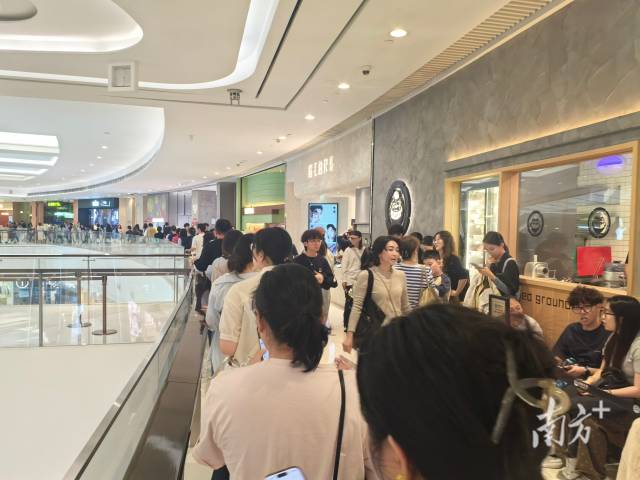
In terms of income, the per capita disposable income of provincial residents reached 16,096 yuan in the first quarter, with a nominal year-on-year growth of 4.4% and a real growth of 3.9% after adjusting for inflation. By residence, urban residents recorded a per capita disposable income of 19,196 yuan (3.9% nominal growth, 3.3% real growth), while rural residents reached 8,473 yuan (5.6% nominal growth, 5.9% real growth).
 Reporters
: Huang Xuhao, Li Fengxiang, Shao Yihong (Nanfang Plus)
On-camera: Huang Xuhao
Design: Liu Zikui
Photography: Zhang Guanjun
Video Editing: Zhou Xinyu